Neue Zürcher Zeitung, 28.6.2000 // Between atmosphere and rhythm – the composer Harald Bluechel
- Kategorie: Press archive
- Tagged: Bartok, Composer, New music, repetitive music, Tangerine Dream, Theater
- Alle Texte
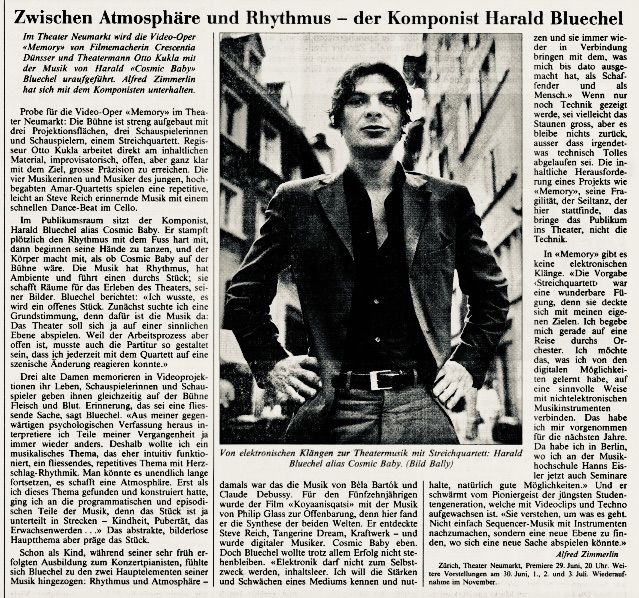
Neue Zürcher Zeitung, 28.6.2000 // Between atmosphere and rhythm – the composer Harald Bluechel
Between atmosphere and rhythm – the composer Harald Bluechel
The video opera “Memory” by filmmaker Crescentia Dünsser and theaterman Ono Kukla with music by Harald “Cosmic Baby” Bluechel premieres at Theater Neumarkt. Alfred Zimmerlin talked to the composer.
Rehearsal for the video opera “Memory” at Theater Neumarkt: the stage is rigorously constructed with three projection screens, three actors and a string quartet. Director Otto Kukla works directly on the content material, improvisationally, openly, but clearly with the aim of achieving great precision. The four musicians of the young, highly talented Amar Quartet play repetitive music, slightly reminiscent of Steve Reich, with a fast dance beat in the cello.
The composer, Harald Bluechel alias Cosmic Baby, is sitting in the audience. He suddenly stomps the rhythm hard with his foot, then his hands start to dance and his body joins in as if Cosmic Baby were on stage.
The music has rhythm, ambience and guides you through the play: it creates spaces for experiencing the theater, its images. Bluechel reports: “I knew it would be an open play. First of all, I was looking for a basic mood, because that’s what music is for: After all, theater is supposed to take place on a sensual level. But because the working process is open, the score also had to be designed in such a way that I could react to a scenic change with the quartet at any time”.
Three old ladies memorize their lives in video projections, actors and actresses simultaneously give them flesh and blood on stage. Memory is a fluid thing, says Bluechel. “From my current psychological state, I always interpret parts of my past differently. That’s why I wanted a musical theme that works more intuitively, a flowing, repetitive theme with a heartbeat rhythm. You could continue it indefinitely, it creates an atmosphere. Only when I had found and constructed this theme did I move on to the programmatic and episodic parts of the music, because the piece is divided into sections – childhood, puberty, growing up…” The abstract, imageless main theme, however, characterizes the piece.
Even as a child, during his very early training as a concert pianist, Bluechel felt drawn to the two main elements of his music: rhythm and atmosphere – at that time it was the music of Bela Bartok and Claude D4ebussy. For the fifteen-year-old, the film “Koyaanisqatsi” with music by Philip Glass became a revelation, because it was here that he found the synthesis of the two worlds. He discovered Steve Reich, Tangerine Dream, Kraftwerk – and became a digital musician. A cosmic baby.
But Bluechel did not want to stand still despite all the success. “Electronics must not become an end in itself, empty of content. I want to know and use the strengths and weaknesses of the medium and always connect them with what has defined me to date, as a creator and as a person.” If only technology is shown, the amazement may be great, but nothing remains except that something technically great has happened. The substantive challenge of a project like “Memory”, its fragility, the tightrope walk that takes place here – that’s what brings the audience to the theater, not the technology.
There are no electronic sounds in “Memory”. “The specification “string quartet” was a wonderful coincidence because it coincided with my own goals. I am currently embarking on a journey through the orchestra. I want to combine what I’ve learned from the digital possibilities with non-electronic musical instruments in a meaningful way. That’s my plan for the next few years. In Berlin, where I now also hold seminars at the Hanns Eisler Academy of Music, I naturally have good opportunities. And he raves about the pioneering spirit of the youngest generation of students, who grew up with video clips and techno. “They understand what it’s all about. Not just imitating sequencer music with instruments, but finding a new level where a new thing could happen.”
Alfred Zimmerlin
Kategorie
Tagged
Andrei Tarkovsky
Anima
Art
Bach
Bartok
Beethoven
Berlin
Biofilia
Biography
Brian Eno
Cage
Capitalism
classical music
Cluster
Composer
Composition
Contemporary history
contemporary music
Corona
Cosmic Baby
Current affairs
Debussy
Dolphins
Ecology
Electro Pop
Enlightment
Fazioli
Feldmann
GDR
Giorgio Moroder
Heroes
History
Interview
John Cage
Kraftwerk
Krautrock
Laurie Anderson
Life
Life experience
Literature
Louis Malle
Mahler
Mahller
Media
minimal music
Monitoring
Mozart
neo classical
Neoliberalism
New music
New York
Noam Chomky
NOM
Peace
Peace movement
Philosophy
Piano
Piano music
Pink Floyd
Politics
Production
prose poetry
Psychology
Recording session
Reflection
Repetition
repetitive music
Roedelius
Romanticism
Ryuichi Sakamoto
School
Sea
Society
Sound
Stellar Supreme
Studio
Sydney Pollack
Synthesizer
Talking Heads
Tangerine Dream
Techno
Techno Pop
Theater
Trance
Trance Music
USA
War
Whales
Works
world view
World view
World view
Yin
Zeitgeist
© 2026 Cosmic Enterprises GmbH — All rights reserved
Umsetzung: Die Webstylisten